The Beauty of Cellular Automata
If you’ve visited my homepage, you might have noticed the animations running along the margins. Those are cellular automata—simple rule-based systems that create surprisingly complex behavior.
I did a research project on Pattern Periodicity in Rule 45 Cellular Automata at the Wolfram High School Summer Research Program, which is why the margin design uses this pattern.
What is a Cellular Automaton?
A cellular automaton is a grid of cells that evolve over time based on simple rules. Each cell is either “alive” (black) or “dead” (white), and its next state depends on its neighbors.
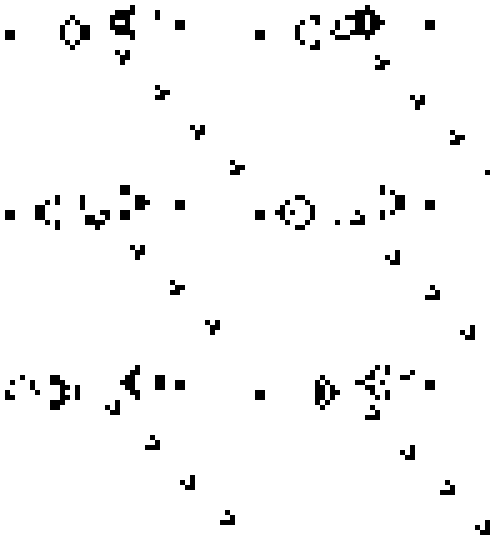
A “glider gun” in Conway’s Game of Life—a pattern that continuously generates moving gliders. (source)
Conway’s Game of Life
Conway’s Game of Life follows four simple rules:
- Live cell with <2 neighbors dies (underpopulation)
- Live cell with 2-3 neighbors survives
- Live cell with >3 neighbors dies (overpopulation)
- Dead cell with exactly 3 neighbors becomes alive (reproduction)
From these rules emerge gliders that travel, oscillators that pulse, and even patterns that can compute.
Elementary Cellular Automata & Rule 45
While Game of Life is 2D, elementary cellular automata work in 1D. They start with a single cell and grow downward like a pyramid.

Rule 30 cellular automaton—each row depends only on the row above it. (source)
Rule 45 produces complex patterns from simple rules. Each cell’s next state depends on itself and its two neighbors (8 possible combinations), following a lookup table derived from the binary representation of 45.
In my research project, I analyzed how patterns repeat along diagonals of Rule 45, discovering period doubling and unexpected period tripling in the data.
Why They Matter
Cellular automata show that complexity emerges from simplicity. You don’t need complicated rules to create interesting behavior—simple primitives can compose into rich patterns.
This idea influences how I think about software and AI: the most elegant solutions often come from finding the right simple building blocks.
Try It Yourself
Play with the patterns on my homepage! Use the dropdown in the bottom-right to switch between automata. Resources:
~Aniruddh Sriram